SoMM2026 : 9th SYMPOSIUM OF THE FRENCH NETWORK ON MONOCYTE-MACROPHAGE
TOULOUSE (France)
3-3 Nov 2026

SoMM2026 : 9th SYMPOSIUM OF THE FRENCH NETWORK ON MONOCYTE-MACROPHAGE
TOULOUSE (France)
3-3 Nov 2026
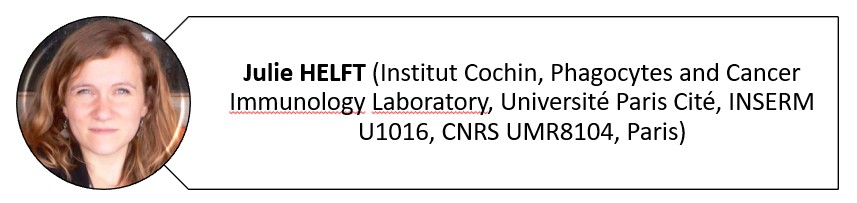
Julie Helft is a senior research director at the Institut Cochin, where she leads the “Phagocytes and Cancer Immunology” team. After completing her PhD in 2006 at Université Paris Descartes under the supervision of Olivier Lantz, with a thesis entitled Identification of a New Mechanism of Negative Regulation of the CD4+ T Cell Response, she carried out a five-year postdoctoral fellowship at the Icahn School of Medicine at Mount Sinai in New York, followed by a second three-year postdoctoral fellowship at the Cancer Research UK London Research Institute.
Her current work investigates how macrophages and dendritic cells shape anti-tumor T-cell immunity, with a particular focus on macrophage heterogeneity in breast cancer and macrophage-targeted immunotherapies.
Julie Helft was awarded an ERC Consolidator Grant for the FOLOME project, which focuses on the role of tissue-resident FOLR2+ macrophages as organizers of the tumor immune microenvironment. The project aims in particular to understand their interactions with anti-tumor cytotoxic T lymphocytes and their potential for the development of new immunotherapies.
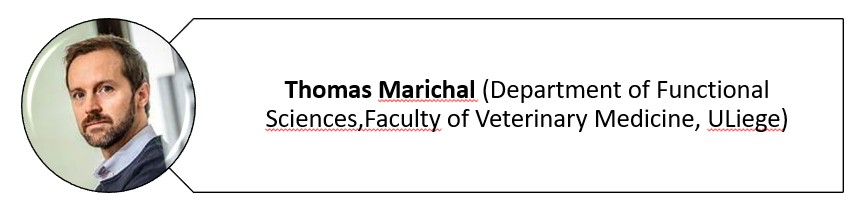
Thomas Marichal holds a Doctor of Veterinary Medicine (DVM) degree and a PhD in Immunology, both obtained at the University of Liège (Belgium) in 2011. He then pursued his training with a postdoctoral fellowship at Stanford University (California, USA) from 2011 to 2014.
Upon returning to Belgium, Thomas Marichal was appointed FNRS Research Associate in 2016 and joined the Welbio program as an investigator. In 2018, he was awarded an ERC Starting Grant by the European Research Council, before joining the academic faculty of the University of Liège in 2019 as Associate Professor of Animal Physiology at the Faculty of Veterinary Medicine.
Thomas Marichal currently heads the Immunophysiology Laboratory at the Interdisciplinary Research Institute in Biomedical Sciences — GIGA — at the University of Liège. He is an internationally recognized researcher in immunology, whose work has received numerous national and international awards, including the prestigious Baillet Latour Biomedical Award.
 Loading...